
7th House Astrology: What Your Chart Says About Partners
Astrology 10 min read
By AstroNumCharts Published Last updated
On this page
Ask an astrologer about love or marriage, and they’ll usually look at one part of your chart first: the 7th house. In 7th house astrology, this slice of the sky describes the people you pair up with, from a spouse to a business partner.
Below, we explain what the 7th house covers and how to find its sign, ruler and planets. We also show why your house system can move a planet in or out. Then we read one sample chart step by step, with every number checked against the Swiss Ephemeris.
What does the 7th house mean in astrology?
The 7th house is the house of partnerships. Astrologers read it for marriage and long-term love, but also for business partners, contracts and any close one-to-one bond. Traditional texts add “open enemies”: rivals you know about, such as the other side in a lawsuit. In short, it shows how you meet other people as equals.
It sits opposite the 1st house, which describes you. That pairing is the key idea. The 1st house is “me,” and the 7th house is “you,” whoever sits across the table.
Libra, the seventh sign, is its natural match, and Libra’s ruler, Venus, is its natural ruler. That’s why Venus comes up so often in relationship readings. The 7th house also begins at one of the chart’s four angles, so it counts as an angular house.
Where is the 7th house in your birth chart?
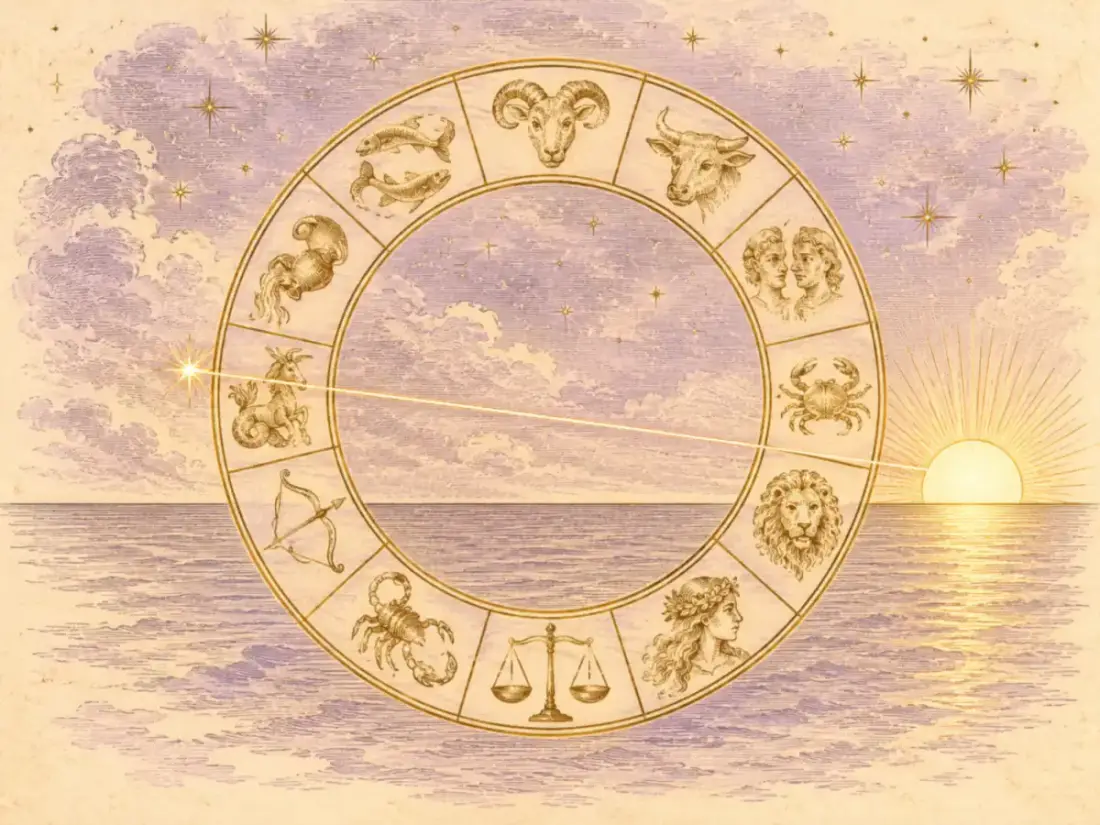
The 7th house starts at the Descendant, the point that was setting in the west when you were born. It’s the exact opposite of your Ascendant, the degree of your rising sign. On a chart wheel, it’s the house just above the horizon line, on the right. Planets in it sat low in the western sky.
As the Earth turns, the Descendant moves through all twelve signs in about a day. That means the 7th house needs an exact birth time. Without one, there is no Descendant and no houses, so our birth chart calculator shows your planets by sign but leaves the houses out.
Know your rising sign but nothing else? Your 7th house sign is the sign opposite it. You can find the rising sign with our rising sign calculator.
How do you find your 7th house sign, ruler and planets?
You need three things from your chart: the sign on the 7th house cusp, the planet that rules that sign, and any planets inside the house. The sign sets the tone. The ruler shows where the story of your partnerships continues. Planets inside add their own color. Here’s how to find all three in a few steps.
- Make your chart. Enter your birth date, time and place in the birth chart calculator. For a Western reading, keep the default Placidus houses.
- Find the Descendant. It’s the line marked DSC on the right side of the wheel. The sign it falls in is your 7th house sign. The “House cusps” table under the chart shows the exact degree.
- Find the ruler. Look up your 7th house sign in the table further down this page. Then find that ruling planet in your chart and note its sign and house.
- List the planets inside. Any planet with a 7 in the House column sits in your 7th house.
Worked example: a sunset birth in Phoenix
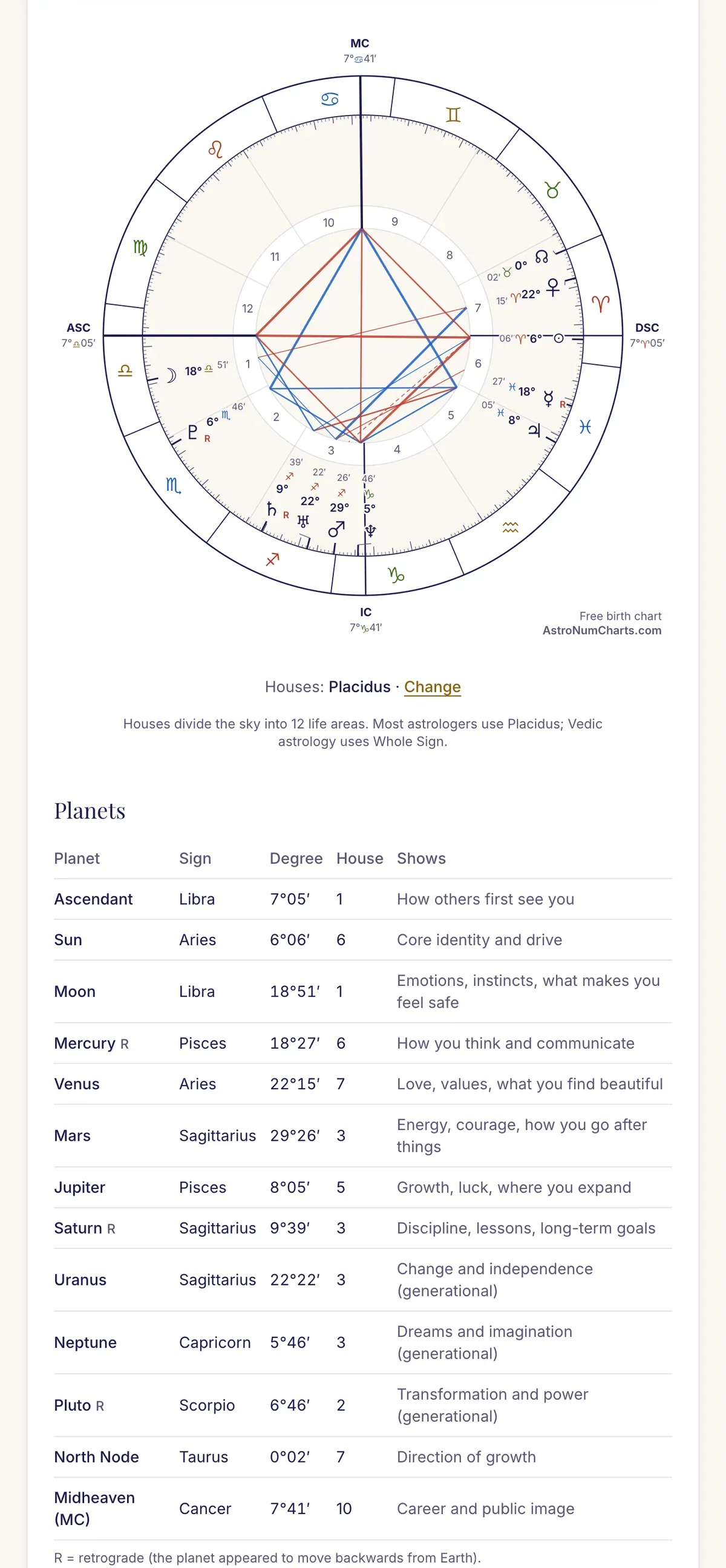
Let’s read one chart. It’s a sample birth, not a real person: March 26, 1986, at 6:45 PM in Phoenix, Arizona. Arizona doesn’t use daylight saving time, so this was 1:45 AM UTC on March 27. By our calculation, the Sun set in Phoenix that evening at about 6:44 PM. This person was born a minute after sunset.
Step 1, the chart. The rising sign is Libra at 7°05′, so the Descendant is Aries at 7°05′. In Placidus houses, that’s where the 7th house begins. It ends at the 8th house cusp, Taurus 4°45′.
Step 2, the sign. The 7th house sign is Aries. In the traditional reading, that points to directness, energy and independence in partners.
Step 3, the ruler. Aries is ruled by Mars. Mars sits at Sagittarius 29°26′ in the 3rd house, the house of conversation, learning, siblings and the neighborhood. A traditional reading would link partnerships with those everyday places. For example, this person might meet partners through a class, a neighbor or a sibling.
Step 4, the planets inside. Venus, at Aries 22°15′, is in the 7th house, and so is the North Node, at Taurus 0°02′. The Sun, at Aries 6°06′, is just under one degree short of the Descendant, so Placidus puts it in the 6th house. That fits the sky: the Sun had just set.
So far we’ve used Placidus. Here is the same birth in other house systems:
| House system | 7th house begins | 7th house ends | Planets in the 7th house |
|---|---|---|---|
| Placidus (our Western default) | Aries 7°05′ | Taurus 4°45′ | Venus, North Node |
| Koch | Aries 7°05′ | Taurus 6°51′ | Venus, North Node |
| Equal | Aries 7°05′ | Taurus 7°05′ | Venus, North Node |
| Whole Sign | Aries 0°00′ | Taurus 0°00′ | Sun, Venus |
| Vedic: sidereal zodiac, Whole Sign | Pisces 0°00′ | Aries 0°00′ | Sun, Venus |
Whole Sign houses start the 7th house at 0° Aries, so the Sun moves in. They also end it at 0° Taurus, so the North Node, just two arcminutes past that line, moves out to the 8th house. Same birth, same planets, but a different list of planets in the 7th house.
We calculated every position above with the same engine our calculator uses. Then we checked it against the Swiss Ephemeris, the engine behind many astrology websites. The two agree within an arcminute everywhere.
Why can a planet move in or out of the 7th house?
Two things decide it: your house system and your birth time. Each house system divides the sky its own way, so the 7th house changes size from one system to the next. And the Descendant moves roughly a degree every four minutes, so a planet close to it can switch houses if your birth time is a little off.
The Phoenix chart shows both. The Descendant stays in Aries for any birth time from about 6:12 PM to 8:34 PM. So the 7th house sign holds even if the time is off by half an hour. The Sun is a different story. For a birth before about 6:40 PM, the Sun would sit on the 7th house side of the Descendant, in Placidus too.
A planet within a degree or two of the Descendant, or of the 8th house cusp, deserves a second look if your birth time was rounded. Read it both ways.
Which house system should you use? Western astrologers mostly use Placidus. Whole Sign houses are older and simpler, and Vedic astrology uses them as standard. Neither is “wrong.” Pick one and read your chart with it consistently. In our calculator, press Change next to “Houses” under the chart to switch.
What does the sign on your 7th house suggest?
In the traditional reading, the sign on your 7th house cusp describes what you look for in a partner and how you handle one-to-one deals. In every house system our calculator offers, it’s the sign opposite your rising sign, so you can read the table from your Ascendant. Each sign also has a ruling planet to look up next.
| Rising sign | 7th house sign (its ruler) | Traditional partner themes |
|---|---|---|
| Aries | Libra (Venus) | Harmony, fairness, charm |
| Taurus | Scorpio (Mars; modern: Pluto) | Depth, loyalty, intensity |
| Gemini | Sagittarius (Jupiter) | Adventure, honesty, big ideas |
| Cancer | Capricorn (Saturn) | Stability, commitment, ambition |
| Leo | Aquarius (Saturn; modern: Uranus) | Friendship, independence, originality |
| Virgo | Pisces (Jupiter; modern: Neptune) | Compassion, imagination, devotion |
| Libra | Aries (Mars) | Directness, energy, independence |
| Scorpio | Taurus (Venus) | Steadiness, comfort, loyalty |
| Sagittarius | Gemini (Mercury) | Conversation, curiosity, variety |
| Capricorn | Cancer (Moon) | Care, home, emotional safety |
| Aquarius | Leo (Sun) | Warmth, confidence, generosity |
| Pisces | Virgo (Mercury) | Practical help, attention to detail, reliability |
Read these as themes, not rules. The ruler’s sign and house, and any planets in the 7th house, usually add more detail than the sign alone.
What do planets in the 7th house mean?
A planet in your 7th house adds its own character to your relationships. In traditional readings, it can describe the qualities you meet in partners, or a part of yourself that you tend to see in other people first. The list below gives the usual reading for each planet, from the Sun out to Pluto.
- Sun: partnership feels central to who you are, and you may come into your own through other people.
- Moon: you look for emotional safety and care in a partner, and your mood often follows your closest bonds.
- Mercury: talk holds your relationships together. It’s also read as a talent for deals and contracts.
- Venus: the natural ruler is at home here, traditionally read as charm and a strong wish for harmony.
- Mars: energy and friction. Partners may be direct and driven, and deals can turn competitive.
- Jupiter: growth and generosity through other people. Tradition counts it among the kindest planets here.
- Saturn: you take commitment seriously and often slowly. Bonds that pass a test tend to last.
- Uranus: a need for freedom and surprise, and room for unusual partnerships.
- Neptune: romance and idealism. The tradition advises seeing partners as they really are.
- Pluto: intense bonds that change you, and a pull toward depth over small talk.
In the Phoenix chart, Venus sits in the 7th house in every system. It is also the natural ruler of this house, which a traditional reading treats as a strong signature for partnership. If you’d like to check Venus in your own chart, our Venus sign calculator shows its sign and, with a birth time, its house. The North Node in this house has a reading of its own; our North Node calculator explains it by sign and house.
What if your 7th house is empty?
An empty 7th house is common, and it doesn’t mean a lack of relationships. There are ten planets and twelve houses, so every chart has at least two empty houses. Look at the sign on the 7th house cusp and, above all, at its ruler. Where that planet sits shows where your partnership themes play out.
Imagine the Phoenix chart without Venus and the Sun. Its 7th house would be empty, but we would still read Mars, the ruler, in the 3rd house. The partnership story wouldn’t disappear. It would simply be told through Mars.
How is the 7th house read in Vedic astrology?
Vedic astrology reads the 7th house for marriage and partners too. But it measures the signs against the stars, using the sidereal zodiac, and usually counts whole-sign houses. So the 7th house is the seventh sign from your rising sign. The two zodiacs sit about 24° apart, so it often falls one sign earlier than in a Western chart.
Many Vedic astrologers call it kalatra bhava, the house of the spouse. Classical texts also group the 7th with the 3rd and 11th houses under kama, desire and enjoyment. Each house covers one full sign of 30°, as the Hindu astrology overview explains.
Venus also plays a special role. In Vedic tradition it is the karaka, or natural significator, of marriage and the spouse. So astrologers read the 7th house and Venus together, whatever sign happens to be on the 7th.
In the Phoenix chart, the sidereal rising sign (Lahiri ayanamsa) is Virgo at 13°26′, so the 7th house is Pisces. Its ruler is Jupiter, at Aquarius 14°25′ in the 6th house. The Sun and Venus both sit in the 7th house, as they do in the Western Whole Sign chart. To see this view of your own chart, switch the birth chart calculator to Vedic.
Can the 7th house predict marriage?
No chart can promise when you’ll marry, or who your partner will be. Astrologers read the 7th house for themes: what draws you to people, what you hope a partner brings, and where relationships tend to test you. We see it as a traditional reading for reflection, not a prediction.
Comparing two people takes both charts, not just one 7th house. For a quick start, our zodiac compatibility calculator compares two birthdays by Sun and Moon signs. For health, money or legal decisions, please speak to a qualified professional.
If you’re new to charts, our guide on how to read your birth chart walks through the planets, signs and houses in order.
Frequently asked questions
Is the 7th house only about marriage?
No. It covers any close one-to-one partnership: a spouse, a long-term partner, a business partner or a client you work with closely. Traditional astrology also reads contracts, agreements and open rivals, such as the other side in a dispute, from the 7th house.
What is the difference between the 7th house and the Descendant?
The Descendant is a single point: the degree that was setting on the western horizon when you were born. The 7th house is the area that begins there in most house systems. In Whole Sign houses, the 7th house begins at 0° of the Descendant’s sign, so the Descendant sits somewhere inside it.
Can I find my 7th house without a birth time?
Not reliably. The Descendant moves through all twelve signs in about a day, so houses need an exact time. Without one, our birth chart calculator shows your planets by sign but leaves the houses out. If you know your rising sign, your 7th house sign is the opposite sign.
Which planet rules the 7th house?
Venus is its natural ruler, because Libra is the seventh sign. In your own chart, the ruler is the planet that rules the sign on your 7th house cusp: Mars for Aries, for example, or the Moon for Cancer.
Is it good to have many planets in the 7th house?
It is neither good nor bad. In the traditional reading, several planets there suggest that partners and one-to-one dealings take up a lot of your attention. Which planets they are, and how they get along with the rest of your chart, matters more than how many there are.