
The 13th Zodiac Sign: Is Ophiuchus Your Real Sign?
Astrology 7 min read
By AstroNumCharts Published Last updated
On this page
Every few years, a headline says there’s a 13th zodiac sign and your star sign has changed overnight. It hasn’t. But the story behind the headline is real, and it’s more interesting than the rumor: the Sun really does pass through a thirteenth constellation every year, and in 2026 it arrives on November 30.
Here’s what that constellation is, the exact days the Sun spends in it, and what it means if your birthday falls in that window. You can also check which constellation the Sun was in on your own birthday.
Is Ophiuchus really a zodiac sign?
Not in astrology. Ophiuchus is one of the 88 constellations astronomers recognize, and the Sun’s yearly path does cross it. But astrology’s zodiac is twelve equal 30° slices of that path, each named after a constellation long ago. Ophiuchus never got a slice, so neither Western nor Vedic astrology counts it as a sign.
The mix-up comes from two words that sound alike. A constellation is an area of sky with official borders, which the International Astronomical Union published in 1930. A sign is a 30° stretch of the Sun’s path, measured from a fixed starting point.
Most signs borrowed their names from constellations, but the two stopped lining up long ago. A few modern astrologers do use a 13-sign zodiac. It’s a recent idea, and we look at where it came from below.
When is the Sun in Ophiuchus?
The Sun enters Ophiuchus around November 29 or 30 and leaves around December 17 or 18, about 18 days later. In 2026 it crosses in at about 12:40 AM Eastern Time on November 30 — still November 29 on the West Coast — and leaves at about 8:10 AM Eastern on December 18.
We worked out these times ourselves from the official constellation borders, using astronomy-engine, the same astronomy library our calculators use. We checked them against EarthSky’s published tables for 2018 and 2021: 25 of their 28 entry dates match ours. The other three are one day apart, because those crossings happen within hours of midnight.
| Year | Sun enters Ophiuchus (Eastern Time) | Sun leaves Ophiuchus (Eastern Time) |
|---|---|---|
| 2024 | Nov 29, about 12:20 PM | Dec 17, about 7:50 PM |
| 2025 | Nov 29, about 6:30 PM | Dec 18, about 2:00 AM |
| 2026 | Nov 30, about 12:40 AM | Dec 18, about 8:10 AM |
| 2027 | Nov 30, about 6:50 AM | Dec 18, about 2:20 PM |
| 2028 | Nov 29, about 12:50 PM | Dec 17, about 8:20 PM |
| 2029 | Nov 29, about 7:10 PM | Dec 18, about 2:30 AM |
| 2030 | Nov 30, about 1:10 AM | Dec 18, about 8:50 AM |
Notice the pattern. The times step about six hours later each year, then jump back a day after each leap day, because a calendar year isn’t exactly as long as the Sun’s year.
Over centuries the window also creeps later. In 1930, when the borders were published, the Sun arrived in Ophiuchus on November 29.
How long does the Sun spend in each constellation?
Very different amounts of time. In 2026 the Sun spends about 44½ days in front of Virgo but only about 6½ days in Scorpius, the shortest stay of all thirteen. It spends about 18 days in Ophiuchus. Astrology’s signs avoid that unevenness: each one is exactly 30°, roughly a month.
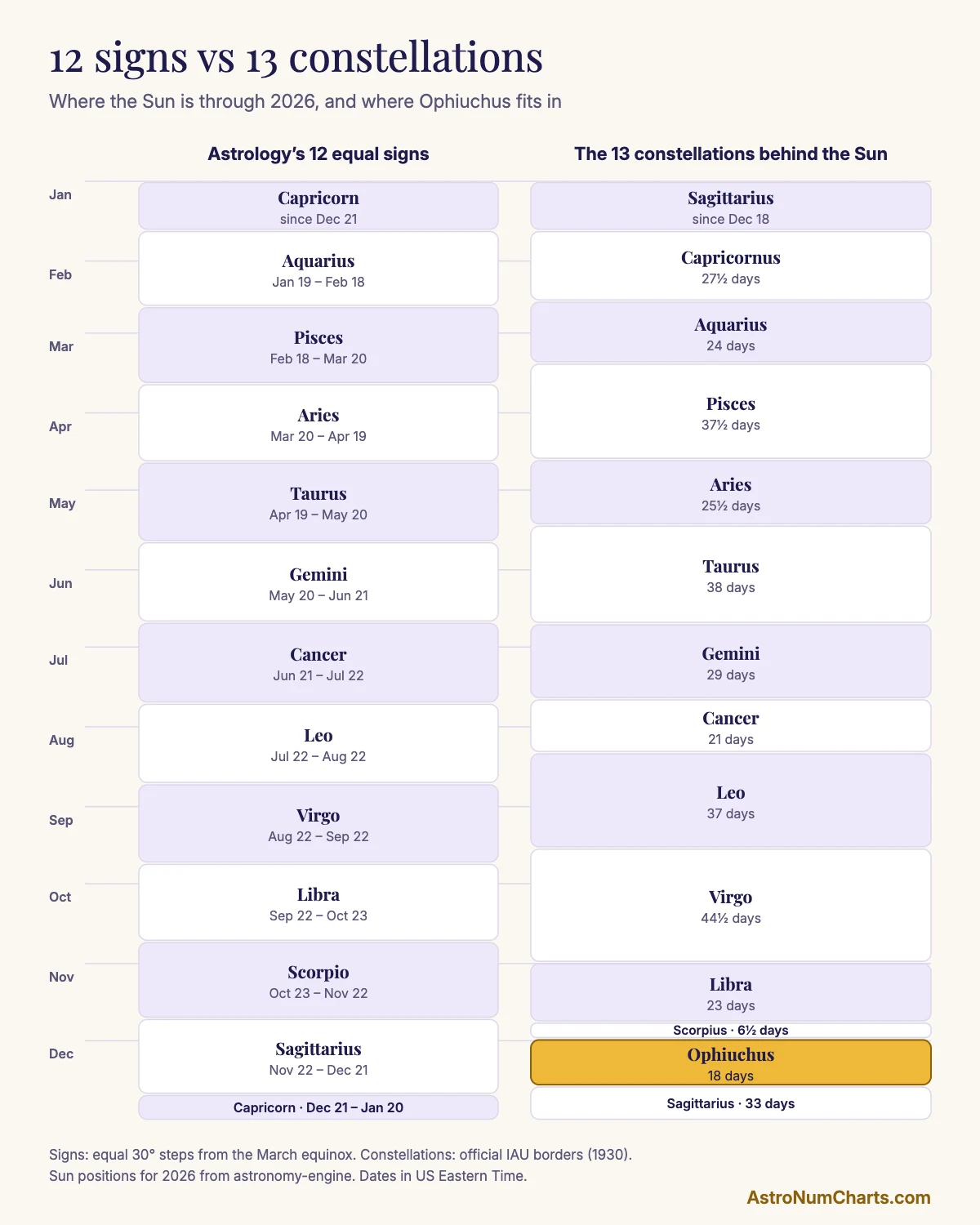
Here is the same year as a table. The last column shows when the astrology sign with the same name begins.
| Constellation | Sun enters it in 2026 | Days there | Sign of the same name begins |
|---|---|---|---|
| Capricornus | Jan 19 | 27.4 | Dec 21, 2025 |
| Aquarius | Feb 16 | 24.1 | Jan 19 |
| Pisces | Mar 12 | 37.5 | Feb 18 |
| Aries | Apr 18 | 25.5 | Mar 20 |
| Taurus | May 14 | 38.3 | Apr 19 |
| Gemini | Jun 21 | 29.2 | May 20 |
| Cancer | Jul 20 | 21.0 | Jun 21 |
| Leo | Aug 10 | 37.0 | Jul 22 |
| Virgo | Sep 16 | 44.5 | Aug 22 |
| Libra | Oct 31 | 23.1 | Sep 22 |
| Scorpius | Nov 23 | 6.5 | Oct 23 |
| Ophiuchus | Nov 30 | 18.3 | — (no sign) |
| Sagittarius | Dec 18 | 32.8 | Nov 22 |
Dates are in US Eastern Time. Look down the last column: every sign starts about a month before the Sun reaches the stars it’s named after. That gap is the next part of the story.
Am I Ophiuchus or Sagittarius?
If you were born between about November 29 and December 18, the Sun stood in front of Ophiuchus on your birthday. In astrology your sign is still Sagittarius in the Western zodiac, and usually Scorpio in the Vedic one. These are three different ways of measuring the sky, so all three answers can be right at once.
Check your own birthday here. It shows the constellation behind the Sun next to your Western and Vedic signs.
Which constellation was the Sun in on your birthday?
A worked example: December 5, 1995
Take a birthday of December 5, 1995, at noon in New York.
- Western sign. The Sun was at 13°04′ Sagittarius, measured from the March equinox. Western astrology says Sagittarius.
- Vedic sign. Vedic astrology measures from the stars instead. It subtracts the Lahiri ayanamsa, almost 24° in 1995, which puts the Sun at 19°16′ Scorpio. Vedic astrology says Scorpio.
- Constellation. The official borders put the Sun inside Ophiuchus from November 30 to December 18 that year. Astronomy says Ophiuchus.
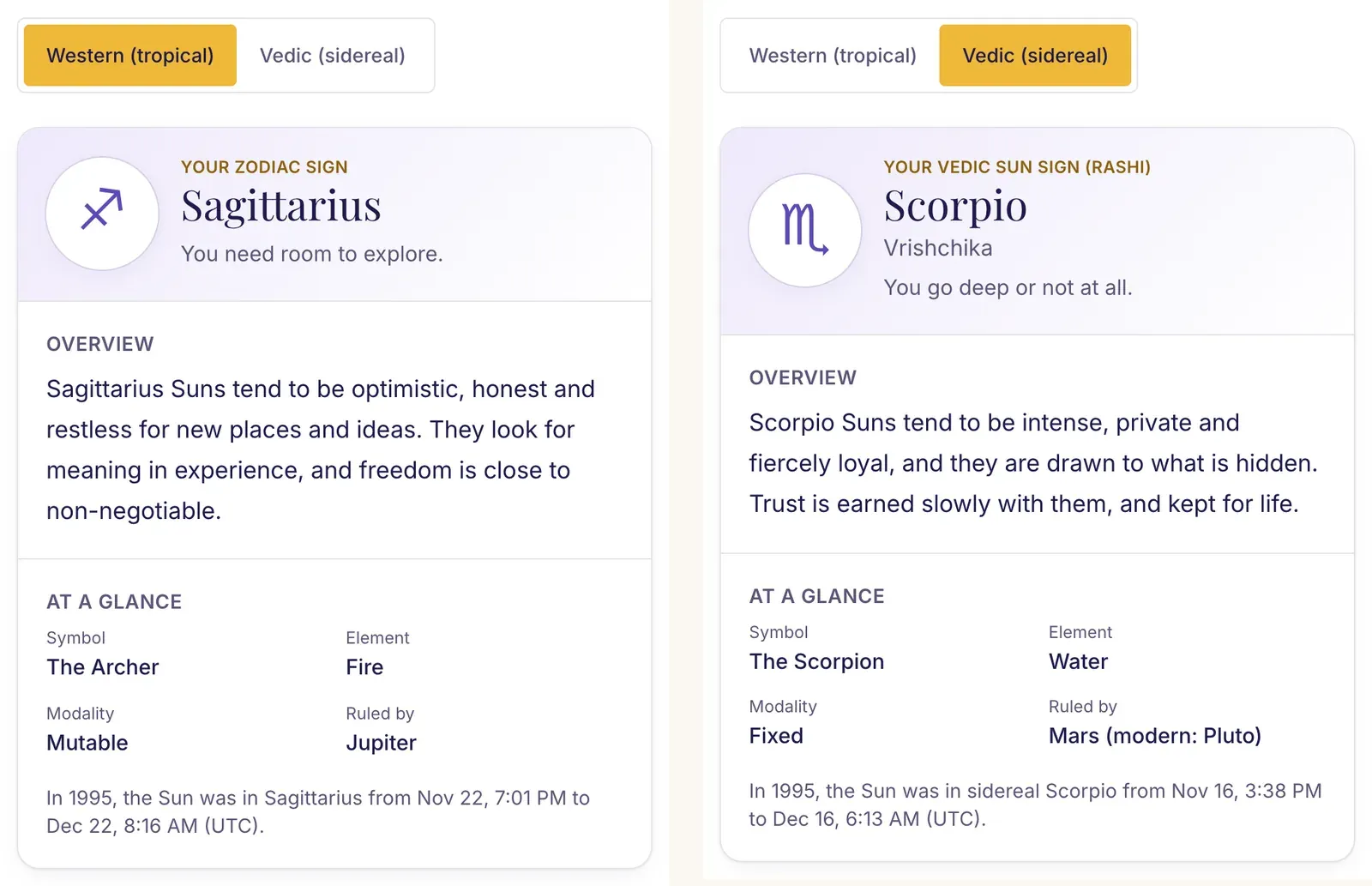
Here’s that birthday in our zodiac sign calculator: the Western result on the left and the same result switched to Vedic on the right.
Why was Ophiuchus removed from the zodiac?
It wasn’t, because it was never in. Babylonian astronomers divided the Sun’s path into twelve equal parts, and NASA explains that they wanted “a tidy match with their 12-month calendar.” So the thirteenth constellation the Sun crosses never got a sign of its own. Equal slices also keep the math simple.
That’s why astrology has twelve signs, not thirteen. The twelve were a way of measuring the year, not a list of every star pattern behind the Sun, and astrologers have used them ever since.
Why don’t the signs match the constellations anymore?
Earth’s axis wobbles slowly, like a spinning top. This wobble, called precession, moves the zodiac’s starting point against the stars by about 1° every 72 years. Over many centuries it has opened a gap of about 24° between the signs and the stars they were named after — almost a whole sign.
The two kinds of astrology handle that gap differently:
- Western astrology ties its signs to the seasons. Aries always starts at the March equinox, wherever the stars sit.
- Vedic astrology ties its signs to the stars and subtracts the gap, called the ayanamsa. By the Lahiri ayanamsa, the standard in India, the two zodiacs matched around the year 285 and are about 24° apart in 2026.
Neither one is wrong; they start counting from different places. You can read more about the Lahiri ayanamsa in how we calculate.
Did NASA change the zodiac?
No. In 2016 a NASA page for kids showed which constellation the Sun was in on each date, and headlines turned it into “NASA changed your sign.” NASA replied on its Tumblr blog: “we didn’t change any zodiac signs…we just did the math,” as TIME reported. The 13-sign idea is much older than that.
Here’s how it grew, according to Wikipedia’s history of the idea:
- 1970: Steven Schmidt’s book Astrology 14 proposes a 14-sign zodiac that adds Ophiuchus and Cetus.
- 1995: Walter Berg publishes The 13 Signs of the Zodiac.
- 2011: An astronomer at the Minnesota Planetarium Society talks about the shifted dates, and the story goes viral.
- 2016: The NASA page for kids sets off the same headlines again.
What does Ophiuchus mean?
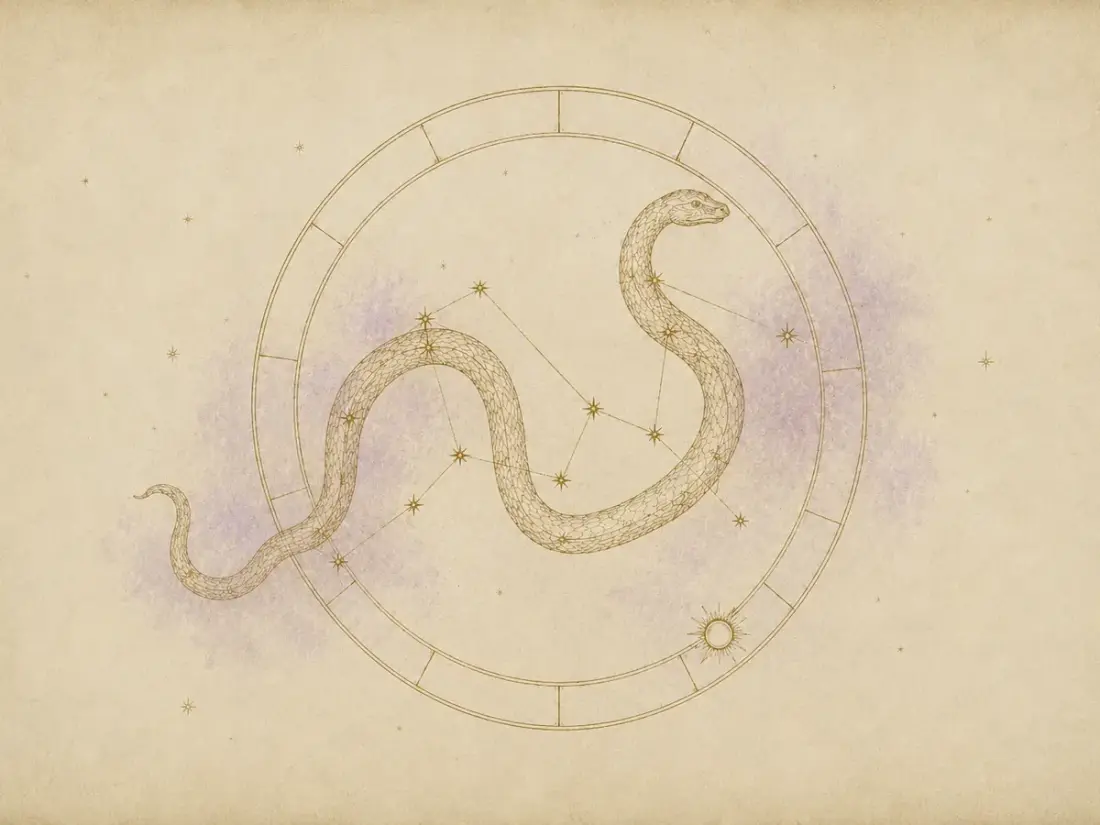
Ophiuchus comes from the Ancient Greek for “serpent-bearer,” and star maps draw it as a man holding a snake. Roman-era writers linked the figure with Asclepius, a healer said to have learned the secret of keeping death away. In modern astrology books, its symbol is ⛎.
You can read the myth on Wikipedia’s Ophiuchus page.
What about Ophiuchus personality traits? Here we have to be honest: traditional astrology has none. The healer-and-seeker profiles you’ll find online are modern ideas drawn from the myth, not from centuries of chart reading. If one speaks to you, that’s fine — just know how new it is.
What it means for your birthday
If your birthday falls between late November and mid-December, nothing about your horoscope changes. Your Western sign is Sagittarius, and your Vedic sign is usually Scorpio.
What you gain is a good story for your next birthday: on the day you were born, the Sun stood in front of the Serpent Bearer. To see where any birthday falls, check the exact zodiac sign dates for your birth year, including the change times on cusp days.
Frequently asked questions
What are the Ophiuchus dates in 2026?
The Sun is in front of Ophiuchus from about 12:40 AM Eastern Time on November 30, 2026, until about 8:10 AM Eastern Time on December 18, 2026. On the West Coast, the start still falls on the evening of November 29.
Who is Ophiuchus compatible with?
No astrology tradition has compatibility rules for Ophiuchus. Compatibility is read from your usual Sun sign, so an early-December birthday counts as Sagittarius in Western astrology. To compare two birthdays, try our zodiac compatibility calculator.
Does Ophiuchus change my horoscope?
No. Horoscopes are written for the twelve signs, and your sign does not depend on where the constellations sit. If you were born in early December, keep reading Sagittarius in Western astrology.
Is Ophiuchus used in Vedic astrology?
No. Vedic astrology uses twelve sidereal signs measured from the stars, plus 27 lunar mansions called nakshatras. Ophiuchus is not one of them, even though the sidereal zodiac follows the stars more closely than the Western one.